Fusing Curiosity with Discovery: February 18 - March 5
Science for Everyone
Each festival features memorable talks, demos, shows and tours for all ages!
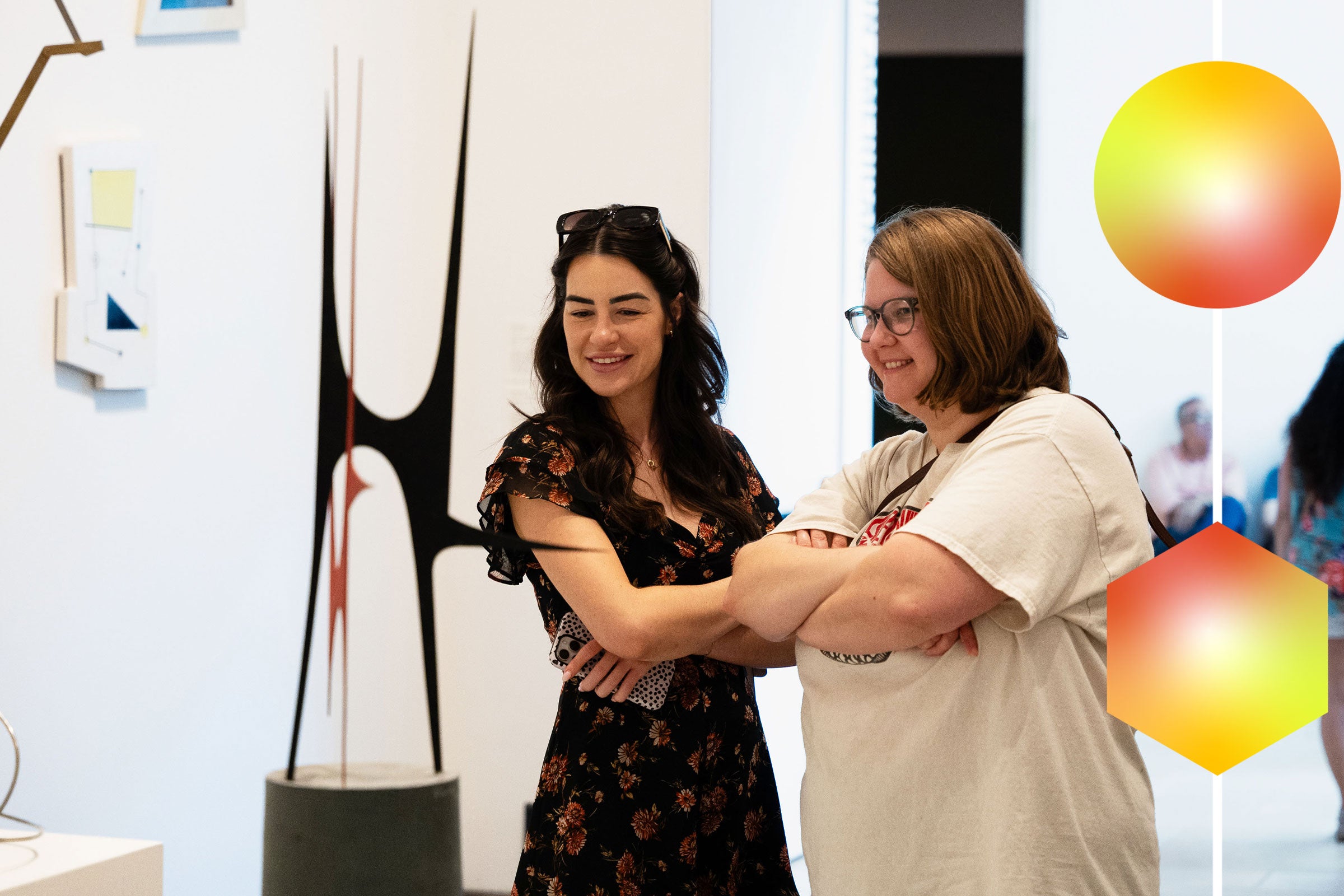
Blanton Museum Public Tour: The STEAM Edition
3:00 pm
– 4:00 pm
•
In Person
Texas Science & Natural History Museum: Guided Tour of Epic Encounters
3:00 pm
– 4:00 pm
•
In Person
Festival Updates
When info, events, opportunities or speakers get updated, make sure you know all the latest. Get notified
Partner-Powered Programming
The Texas Science Festival is made possible with generous support from our donors and involvement from dozens of partners in the community and across The University of Texas at Austin.
Through the Texas Science Festival, we hope to share the sense of discovery and awe at the heart of our disciplines with Texans everywhere.”
David Vanden Bout
Dean, College of Natural Sciences, The University of Texas at Austin
Show-Stopping Speakers
The festival brings leading experts and award-winning science enthusiasts to Texas.
Brian Malow
Science Comedian
Brian Malow (B.A. ’85) is a stand-up comedian and science communicator whose unique blend of comedy and science has been entertaining audiences from TEDx Berkeley to Los Alamos National Lab to the Lindau Nobel Laureate Meetings. Malow has appeared on Science Friday, Neil Tyson’s StarTalk Radio, the Science Channel, the Weather Channel and the Late Late Show with Craig Ferguson. You can see him currently streaming in the documentary “Science Friction” and on “The Unbelievable,” hosted by Dan Aykroyd on the History Channel. Malow has produced science videos for Time Magazine and Slate and written for Scientific American, American Scientist and Symmetry Magazine. He has worked with NASA, NSF, AAAS, NIST and many other acronyms, as well as Lawrence Berkeley Lab, Johns Hopkins Medicine, Apple, Google and Microsoft. He’s been featured in the New York Times, San Francisco Chronicle and Washington Post. The California Academy of Sciences named Malow one of their inaugural Osher Science Communication Fellows.
Melissa Kemp
Associate Professor
Department of Integrative Biology, UT Austin
Melissa Kemp is an evolutionary biologist who uses the fossil record and historical data to investigate species responses to global change phenomena. Also appointed in the Department of Earth and Planetary Sciences at UT Austin, she earned her B.A. in biology from Williams College and her Ph.D. in biology from Stanford University, where she was a National Science Foundation (NSF) Graduate Research Fellow, a Stanford DARE Fellow and a National Geographic Young Explorer. She then served as an NSF Environmental Fellow at Harvard University, where she completed her postdoctoral research at the Harvard Center for the Environment. There she investigated how past global change forces have altered species distributions in Anolis lizards, helping reveal population trajectories before, during and after environmental perturbations and providing a framework for evaluating future range shifts. She has served on the faculty of the Department of Integrative Biology at UT Austin since 2018, publishing widely on how vertebrate biodiversity and communities have responded to past environmental change—integrating conservation paleobiology, evolutionary ecology and paleontology to study extinction, diversification, colonization and trait-based responses to global change through deep time. Her research in Texas and in the Caribbean illuminates trends from the last 30,000 years that can shed light on major questions about the roles of climate and human migration in determining the fate of various species.
Francis Collins
Physician, Scientist and Author
Dr. Francis Collins is a physician-geneticist known for leading the Human Genome Project, directing the National Institutes of Health for 12 years and advancing landmark discoveries of disease genes. Early in his research career, he co-led teams that discovered the genetic cause of cystic fibrosis, neurofibromatosis and Huntington's disease. With him at the helm from 1993 - 2003, the International Human Genome Project produced a finished sequence of human DNA. He then used this new data to help create powerful tools and strategies to advance biological knowledge about humans and improve their health. Along with his research, Collins has also stressed the importance of considering the ethical and legal issues surrounding genetics. His leadership at NIH spanned three presidencies and guided major initiatives in areas such as diabetes, Alzheimer’s, cancer, precision medicine and the COVID-19 response. After serving as Acting Science Advisor to the president, he returned to his NIH lab to study genetic factors in diabetes and aging before retiring in 2025.
A prominent voice on the relationship between science and faith, Collins wrote the bestselling book “The Language of God” and founded the BioLogos Foundation to foster dialogue on these topics. Collins received a B.S. from the University of Virginia, a doctorate in physical chemistry from Yale University and a medical degree from The University of North Carolina. He is an elected member of both the National Academy of Medicine and the National Academy of Sciences, was awarded the Presidential Medal of Freedom in November 2007, and received the National Medal of Science in 2009. In 2020, he was elected as a Foreign Member of the Royal Society (UK) and was also named the 50th winner of the Templeton Prize, which celebrates scientific and spiritual curiosity. In addition to his book on science and faith, Collins has authored a book on personalized medicine, The Language of Life, published by HarperCollins in January 2010. His most recent book is “The Road to Wisdom: On Truth, Science, Faith and Trust,” published in 2024.
Karen Olsson
Author and Editor
Karen Olsson is a writer of fiction and nonfiction. Her 2019 book, The Weil Conjectures, tells the stories of siblings André Weil, a mathematician, and Simone Weil, a philosopher, essayist, and spiritual thinker, interwoven with vignettes of other mathematicians’ lives and work. She is the author of two previous novels, All the Houses and Waterloo, and will publish a new novel in the fall of 2026, Dear Thorns. Her books have been recognized by the New York Times, PEN New-England, and the Texas Institute of Letters. As a journalist, she has explored a variety of politics, science, and human interest subjects, in pieces for Texas Monthly, The New York Times Magazine and other publications. She lives in Austin with her family.
Texas Science Festival in the News
Texas Science Festival Invites Community to Partake in the Joys of Discovery
From a talk-show themed night with science comedy to a campus-wide day for hands-on STEM exploration, the 2026 Texas Science Festival offers something for everyone.
Texas Science Adventure
Scanning a QR code at events, participants earned points, tackled challenges and won prizes, like a festival t-shirt, calendar or entry for a grand-prize giveaway: a special stay at the McDonald Observatory.